
SAT Mathematics: Structure, Skills, and Strategy
The SAT Mathematics section is designed to measure how effectively students apply mathematical reasoning to academic and real-world scenarios. Rather than emphasizing rote memorization, the exam evaluates conceptual clarity, logical thinking, and the ability to interpret and solve problems efficiently. As a result, success depends not only on knowing formulas but on understanding when and how to use them.
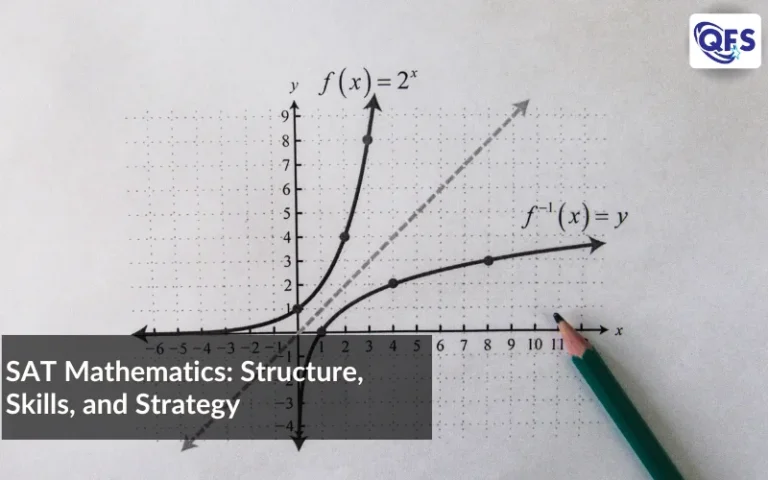
A strong performance in SAT Mathematics can significantly enhance a student’s overall SAT score and strengthen college applications, especially for STEM-focused pathways. Therefore, developing accuracy, speed, and strategic problem-solving skills is essential. With structured preparation and consistent practice, students can build confidence and approach the exam with clarity and control.
Overview of SAT Mathematics
The SAT Mathematics section focuses on key areas that reflect college-level readiness. Questions emphasize logic, modeling, and interpretation. Students encounter:
- Algebraic reasoning
- Problem-solving with data
- Advanced math concepts
- Geometry and trigonometry
Each question is designed to assess conceptual understanding and practical application.
Key Content Areas
1. Algebra
Algebra forms the foundation of SAT Mathematics. It tests how well students manipulate expressions and solve equations. Typical topics include:
- Linear equations
- Systems of equations
- Inequalities
- Functions
Algebra forms the foundation of SAT Mathematics. It tests how well students manipulate expressions and solve equations. Typical topics include:
2. Problem-Solving and Data Analysis
This area measures quantitative reasoning using data. Students interpret tables, graphs, and statistical summaries. Common tasks involve:
- Ratios and percentages
- Unit conversions
- Scatterplots
- Probability basics
Accuracy and interpretation are crucial here.
3. Advanced Mathematics
Advanced math questions assess readiness for higher-level coursework. They demand deeper conceptual thinking. Students may face:
- Quadratic equations
- Polynomial expressions
- Exponential functions
- Nonlinear relationships
These problems often require multi-step solutions.
4. Geometry and Trigonometry
Geometry and trigonometry test spatial reasoning and formula application. Key topics include:
- Area and volume
- Circles
- Angles
- Right-triangle trigonometry
Visualization and precision matter greatly.
Book a Free SAT Consultation Today
Types of Questions
The SAT Mathematics section includes multiple formats to assess different skills. Both formats require careful calculation and logical reasoning.
- Student-Produced Response– Enter your own numerical answer
- Multiple Choice– Choose the correct answer from options
Skills Measured in SAT Mathematics
The section evaluates several core competencies:
- Mathematical fluency
- Problem-solving ability
- Analytical reasoning
- Strategic thinking
Success depends on both knowledge and execution.
Calculator Use in SAT Mathematics
Certain portions allow calculator use, while others emphasize mental math and algebraic manipulation. Students should:
- Use calculators strategically
- Avoid overreliance
- Practice non-calculator techniques
Efficiency often outweighs complex calculations.
Proven Preparation Strategies
Many students lose marks due to avoidable errors:
- Build Conceptual Clarity– Understanding “why” behind formulas improves retention and accuracy.
- Practice with Realistic Questions– Consistent exposure to SAT-style problems sharpens speed and confidence.
- Strengthen Weak Areas-Targeted practice in difficult topics yields faster improvement.
Attentive reading helps prevent these issues.
Get into top universities: expert advice on your application
final thoughts
Excelling in SAT Mathematics requires more than basic subject knowledge; it demands precision, analytical reasoning, and disciplined preparation. Students who focus on strengthening core concepts, practicing regularly, and analyzing mistakes tend to achieve more consistent improvements. Equally important is mastering time management and learning when to use calculator shortcuts effectively.
By approaching preparation strategically, students can reduce test anxiety, improve accuracy, and maximize scoring potential. Over time, steady practice combined with conceptual clarity transforms challenging problems into manageable tasks. Ultimately, confidence in SAT Mathematics is built through understanding, repetition, and smart exam strategy.
WhatsApp us