

Digital SAT Outcomes Across QFS Students: Scores, Trends and What...
IGCSE to IB or IGCSE to A Level: Which Should You Choose?
10th November, 2026 | Abhishek Malani | 13 Min Read
Introduction
After completing IGCSE, students face an important decision about their senior-secondary education: should they continue with Cambridge International A Levels or move to the International Baccalaureate Diploma Programme (IB DP)?
Neither pathway is automatically better. The right choice depends on the student’s academic interests, preferred learning and assessment styles, university plans and ability to manage the programme’s demands. This guide by Quest For Success compares the two qualifications and explains what students and parents should consider before making a decision after Grade 10.
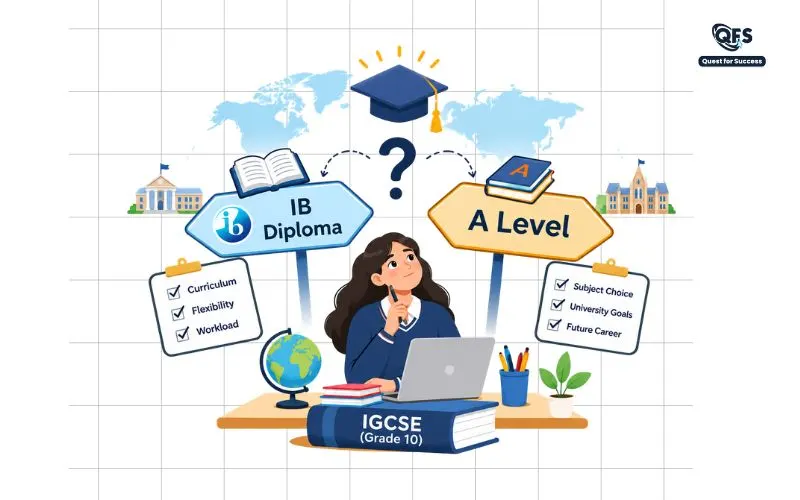
Table of Contents
Breadth vs Depth: How Do the IB and A Levels Differ?
The most important difference between the IB Diploma Programme and A Levels is how students approach subject selection. The IB is designed to maintain breadth across several academic disciplines while allowing students to study selected subjects at a higher level. A Levels, on the other hand, allow students to concentrate on a smaller number of subjects and develop more specialised knowledge.
This distinction affects not only what students study, but also how they prepare for university and manage their workload.
How subject selection works in the IB DP
The IB Diploma Programme is built around six subject groups:
- Studies in Language and Literature
- Language Acquisition
- Individuals and Societies
- Sciences
- Mathematics
- The Arts
Alongside the six subjects, every Diploma student must complete the three Core components:
- Theory of Knowledge (TOK)
- Extended Essay (EE)
- Creativity, Activity, Service (CAS)
How subject selection works in A Levels
Cambridge International A Levels follow a more specialised structure. Students usually choose three or four subjects to study at an advanced level, based on their academic interests and intended university course. There is no compulsory requirement to select subjects across six academic groups. This allows students to spend more time developing knowledge within their selected subjects rather than maintaining a broad combination across different disciplines.
However, specialisation makes subject selection particularly important. Some university courses require specific A Level subjects or combinations, and students may find it difficult to pursue certain degrees if they exclude a prerequisite after IGCSE.
Students should therefore consider three things before finalising their choices:
- Their strengths and performance in relevant IGCSE subjects.
- The subjects they genuinely enjoy and are willing to study in greater depth.
- The entry requirements for the university courses they may pursue.
Academic Workload: Is IB Harder Than A Levels?
Both programmes create different kinds of academic pressure, and the experience also depends on the student’s subject choices and the school’s expectations.
IB DP workload
IB students manage six academic subjects alongside the three Core components. Their responsibilities typically include:
- Six academic subjects: Students must keep up with different syllabuses, assignments and assessments across all six subjects, including their HL and SL courses.
- Internal Assessments (IAs): Many subjects include internally assessed work. Depending on the subject, this may involve investigations, experiments, written assignments, oral work or other projects.
- Extended Essay: Students conduct independent research and produce an essay of up to 4,000 words. This requires choosing a topic, developing a research question, gathering and analysing information, and meeting deadlines.
- Theory of Knowledge: Students complete assessed components that include an exhibition and an essay. TOK requires them to engage with questions about knowledge across different areas.
- CAS: Students participate in sustained experiences across Creativity, Activity and Service, reflect on their learning and document their engagement.
- External examinations: Students sit examinations at the end of the programme, with subject-specific assessment arrangements.
A Level workload
A Level students generally study three or four subjects at an advanced level. Their workload is concentrated in these selected areas and can include:
- Advanced subject content: Students study fewer subjects than IB Diploma students, but the content within each subject is more specialised and demanding.
- Subject-specific examinations: Assessment varies by subject and may involve multiple written papers.
- Practical assessments: Relevant Science subjects may include practical examinations or other practical assessment components.
- Coursework and projects: Certain subjects include coursework or practical projects, although this is not a universal requirement across A Levels.
- Independent revision: Students need to consolidate subject knowledge, practise examination questions and prepare for assessments throughout the programme.
- Staged assessment: Depending on the subject and route, students may complete AS Level in the first year and progress to the full A Level, or sit all the required assessments at the end of the course.
Which programme may feel more demanding?
Rather than deciding which qualification is harder, students should consider the type of work they find most manageable.
- If a student prefers focusing on fewer subjects: The A Level structure may feel more manageable because students can concentrate on three or four areas.
- If a student enjoys academic variety: The IB may be appealing because it allows students to continue studying different disciplines.
- If a student struggles with overlapping deadlines: They should ask how the school schedules internal assessments, coursework, projects and examinations.
- If a student prefers final examinations: They should examine the assessment structure of their chosen A Level subjects. Some rely heavily on examinations, while others include coursework or practical components. The IB also combines examinations with internal assessment, so it is important to compare actual subjects rather than rely on general assumptions.
Assessment and Grading: How Are IB and A Level Students Evaluated?
IB DP assessment
Each of the six IB Diploma subjects receives a final grade from 1 to 7, with 7 being the highest. This gives students a maximum of 42 points from their subject results.
Students can earn up to three additional points through the combined assessment of Theory of Knowledge and the Extended Essay. This brings the maximum possible Diploma score to 45 points.
CAS must also be completed to meet the Diploma requirements, but it does not contribute numerical points to the final score.
IB assessment combines external examinations with internal assessment. The balance varies by subject.
Importantly, achieving a particular total score does not automatically guarantee the IB Diploma. Students must also meet the programme’s subject-grade and Core requirements.
A Level assessment
Cambridge International A Levels award a separate grade for each subject. Full A Level grades generally range from A* to E, with U indicating an ungraded result. AS Level qualifications are graded separately, from a to e.
Assessment structures vary across subjects:
- Some subjects are assessed entirely through written examinations.
- Science subjects may include practical examinations.
- Certain subjects include coursework or project-based components.
- Some subjects have multiple papers that assess different areas of the syllabus.
Students may take AS and A Level examinations in stages or follow a linear assessment route, depending on the subject and examination structure.
What should students consider about assessment preferences?
When choosing between the two programmes, students should think about how they prefer to demonstrate their learning.
- Do they prefer having several components contribute to their final result, or would they rather focus on examinations?
- Are they comfortable managing long-term coursework and internal assessment deadlines?
- Do they perform well in high-stakes examinations?
- Do they enjoy research, essays, practical investigations and presentations?
University Admissions: IB vs A Levels in the UK, US and India
Both the IB Diploma Programme and Cambridge International A Levels are established qualifications for university applications internationally. In many cases, the student’s subject choices and grades have a more direct impact on eligibility than whether they followed the IB or A Levels.
Applying to universities in the UK
UK universities accept both the IB Diploma and A Levels. Entry requirements vary by university and course, and may be expressed as specific A Level grades, an overall IB Diploma score and required HL grades. Some universities also use UCAS Tariff points.
The subject requirements for the intended degree are particularly important.
IB applicants may need to achieve specified grades in particular HL subjects, while A Level applicants may need particular subjects at specified grades. Universities may also require admissions tests, interviews, written work or other assessments for certain courses.
Applying to universities in the United States
US universities accept applications from students following different international curricula, including the IB DP and Cambridge International A Levels.
Unlike many UK applications, US undergraduate admissions generally consider a wider application profile. Universities may assess academic performance in the context of the student’s school curriculum, the subjects available to them, the level of academic challenge they pursued and their wider application.
IB applicants present their six subject choices, HL and SL levels, predicted or final grades and other relevant application components. Students may also draw on experiences from the IB Core when discussing their academic interests, research and extracurricular engagement in their applications.
A Level applicants present their selected subjects, predicted grades and final examination results. Their subject choices can demonstrate academic depth and preparation for a particular field. Students can also develop a broader application through extracurricular activities, personal projects, leadership and other interests outside their qualification.
Some US universities award advanced standing or university credit for particular IB or A Level results.
Applying to universities in India
Both the IB Diploma and Cambridge International A Levels can be considered for undergraduate admissions in India. Universities may set their own criteria for:
- Minimum subject combinations.
- Required marks or grades.
- Class 12 equivalence and supporting documentation.
- Entrance examinations.
- Course-specific eligibility.
Recognition of a qualification does not automatically establish eligibility for every degree. Universities may set additional subject, grade and entrance-examination requirements, particularly for competitive or regulated courses.
Does choosing IB or A Levels improve university admission chances?
Neither qualification guarantees admission to a particular university. The more useful question is whether the programme allows the student to take the right subjects, achieve strong results and build an application suited to their intended destination.
- For UK admissions: Course-specific subject requirements and academic grades are particularly important.
- For US admissions: Universities consider academic performance in the context of the student’s curriculum, alongside the wider application.
- For Indian admissions: Qualification recognition, subject eligibility, minimum grades and entrance examinations can determine whether a student is eligible.
Subject Flexibility and University Course Requirements
Choosing subjects after IGCSE is not simply a question of which programme offers more choice. Students need to consider whether their subject combination will meet the requirements of the university courses they may want to pursue.
Common subject considerations for selected university courses
The following table outlines some common subject considerations. These are general examples, not universal admission rules. Requirements vary between universities and individual degree programmes.
| Intended university course | IB DP considerations | A Level considerations |
|---|---|---|
|
Engineering
|
Check whether Mathematics and Physics are required at HL. Chemistry may also be relevant depending on the course.
|
Mathematics and Physics are commonly important. Further Mathematics may be useful or required for some programmes.
|
|
Medicine
|
Check Biology and Chemistry requirements, including the required HL subjects and grades.
|
Biology and Chemistry are commonly required. Additional Science requirements vary by university.
|
|
Economics |
Check Mathematics requirements and whether the university specifies HL Mathematics.
|
Mathematics is required by some competitive programmes. Economics and Further Mathematics may also be relevant.
|
These examples are intended as starting points for subject research. Students should check the published entry requirements of individual universities in their intended destination country before finalising their choices.
What if the student is undecided about university?
Not every student has a clear degree or career plan immediately after Grade 10. In this situation, subject selection should preserve relevant options without creating an unnecessarily demanding combination.
The IB DP maintains breadth through its six subject groups. This allows students to continue studying languages, humanities, sciences and mathematics even if they have not settled on a particular academic direction.
A Level offers a different kind of flexibility. Students can choose combinations that keep more than one possible degree area open, but they should be careful about dropping subjects that may later become prerequisites. For example, a student considering both Economics and Engineering should investigate Mathematics requirements before choosing an A Level combination that excludes it.
A useful approach is to:
- Identify at least two or three plausible degree areas, even if these are broad.
- Look up the subject requirements for universities in the likely destination countries.
- Check whether the required subjects are available at the intended school.
- Discuss possible combinations with the school’s university counsellor before making a final decision.
Students do not need to have their entire career mapped out at 16. However, they should understand which subject choices could limit their options later.
Cost of IB vs A Levels in India
The cost of studying the IB Diploma or Cambridge International A Levels depends largely on the school offering the qualification. Both are commonly available at private and international schools, and fees can vary considerably by city, facilities, boarding arrangements and the services included.
When evaluating the cost of the two programmes, parents should look beyond annual tuition and calculate the full expense across both years.
Consider:
- Total two-year tuition: Add the fees for both years, accounting for any scheduled increases.
- Examination fees: Check whether IB examination registration or Cambridge AS and A Level examination entries are included in tuition. Some schools charge these separately.
- CAS-related expenses: Ask whether CAS activities, trips, materials or other experiences involve additional charges.
- Subject-specific costs: Practical work, laboratory materials, coursework and project expenses may add to the total.
- University counselling: Check whether individual counselling and application support are included or charged separately.
- Other school expenses: Account for books, technology, transport, meals, uniforms and optional activities.
- Changing pathways: If the student later switches programmes or schools, consider possible additional admission, examination and learning-material costs.
How to Choose Between IB and A Levels After IGCSE
By this stage, students and parents should have a clearer understanding of the differences between the two qualifications. The final decision should bring together academic interests, subject requirements, workload, assessment preferences, university plans and affordability.
| If your priority is… | Consider the IB DP if… | Consider A Levels if… |
|---|---|---|
|
Academic breadth
|
You want to continue studying six subjects across different disciplines.
|
You are comfortable choosing a smaller number of subjects.
|
|
Subject specialisation
|
You want to pursue selected HL subjects while maintaining breadth.
|
You want to concentrate on three or four advanced subjects.
|
|
Research |
You are interested in completing the Extended Essay and other research-based work.
|
You prefer subject-specific study without a compulsory programme-wide research essay.
|
|
Coursework
|
You are comfortable managing internal assessments across subjects.
|
You prefer the assessment structure of your selected A Level subjects.
|
|
Extracurricular engagement
|
You are willing to complete and document CAS experiences.
|
You prefer extracurricular activities to remain separate from your qualification requirements.
|
|
University plans
|
You want a broad academic programme and can meet the required HL subject choices.
|
You have identified subjects that align with your intended degree.
|
|
Undecided academic interests
|
You want to maintain exposure to multiple disciplines.
|
You can choose a combination that keeps your likely degree options open.
|
|
Assessment preference
|
You are comfortable with a combination of external examinations, internal assessments and Core requirements.
|
You prefer the assessment structure offered by your selected subjects.
|
How Quest for Success Can Help
At Quest For Success, we provide personalised tutoring for IB and Cambridge International A Level students, helping them strengthen subject knowledge, address learning gaps and prepare for internal assessments and final examinations. Through tailored academic support and focused exam preparation, we help students work towards their individual learning goals and approach their senior-secondary studies with confidence. To learn more, reach out to us today, and book a free demo class!
Summary
Choosing between the IB Diploma Programme and A Levels after IGCSE depends on a student’s academic interests, preferred learning and assessment styles, university plans and budget. While the IB offers a broader curriculum with six subjects and three Core components, A Levels allow students to specialise in three or four subjects. Students should consider their strengths, research university prerequisites and compare the programmes available at their intended schools before making a decision. Ultimately, the right pathway is one that supports their academic goals and keeps their future opportunities open.
Explore More IB Resources
Planning your academic journey and considering different international education pathways? These resources can help you understand curriculum transitions, compare qualifications, choose the right IB subjects, and explore university opportunities.
- IGCSE to IB Transition – understand the differences between IGCSE and IB, explore subject continuity, and prepare for the academic transition to the IB Diploma Programme.
- A Level vs IB for UK University Admissions – compare A Levels and the IB Diploma in terms of curriculum structure, assessment, subject choices, and UK university admission requirements.
- IB Diploma Fees in India – explore the costs associated with the IB Diploma Programme, including school fees, additional expenses, and factors to consider when budgeting for an IB education.
- IB Score to Percentage – understand how IB Diploma scores are converted into percentages and how Indian universities evaluate IB results for undergraduate admissions.
- CBSE vs IGCSE vs IB vs State Boards – compare India’s major education boards based on curriculum structure, teaching approaches, assessment methods, and suitability for different academic goals.
- IB DP Subject Selection – learn how to choose the right IB Diploma subjects and HL/SL combinations based on your academic strengths, interests, and future university requirements.
- Top Universities for IB Students – explore leading universities that welcome IB graduates and understand how an IB Diploma can support your undergraduate admission opportunities worldwide.
FAQs
The choice depends on whether you prefer academic breadth or subject specialisation. The IB DP requires six subjects across different disciplines, alongside TOK, the Extended Essay and CAS. A Levels usually involve three or four subjects studied in greater depth. Consider your academic interests, assessment preferences and intended university course before deciding.
Neither is universally better. UK universities accept both the IB Diploma and A Levels. However, individual courses may specify particular A Level subjects and grades or IB HL subjects and scores.
US universities accept both qualifications. Their admissions processes generally consider academic performance in the context of the student’s curriculum, subject choices, available opportunities and wider application.
Switching may be possible, but it depends on the timing, the school’s admission policies, subject availability and differences between the syllabuses. Students may need to catch up on content or change their subject combinations. Switching partway through a programme can be particularly difficult because of ongoing assessments and examination registration deadlines.
Yes. Both the IB Diploma and Cambridge International A Levels can be used for undergraduate applications in India. Students must check the required subjects, grades, documentation and entrance examinations for their intended course.
Looking for expert-led tutoring for your IB or A-Level subjects? Reach out to Quest for Success; we are here to help you build a plan around your actual calendar.
While You're Here

SAT Prep Course vs Self-Study vs Private Tutor: Which Should You Choose?
How to Prepare for the SAT: Course, Self-Study, or Private...

Why Most SAT Coaching Still Teaches the Paper Test
Why Most SAT Coaching Has Not Adapted to the Digital...
WhatsApp us