
Introduction: What Is IGCSE in India?
IGCSE in India has grown significantly in popularity over the last decade. Many Indian families now consider it a strong alternative to CBSE or ICSE. The Cambridge IGCSE is offered by Cambridge Assessment International Education. It is globally recognised and prepares students for higher education worldwide.
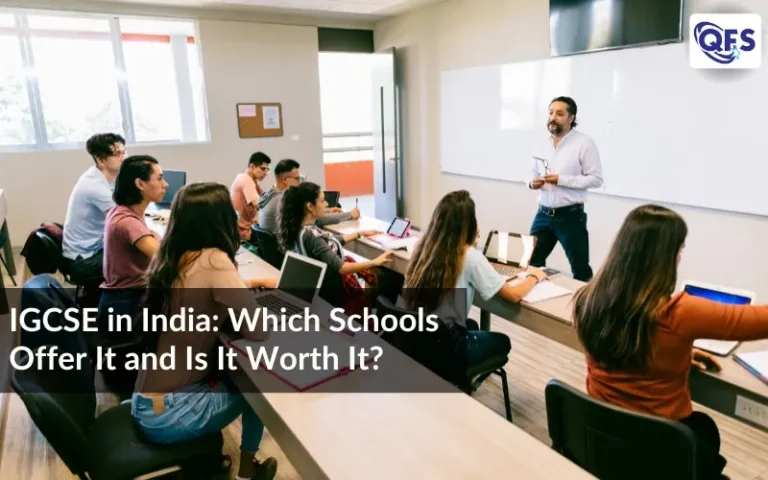
At Quest For Success, we actively support students pursuing IGCSE education in India. The curriculum develops critical thinking, research skills, and subject depth. Students typically sit for IGCSE exams at the end of Grade 10. Overall, it is a well-structured qualification that travels well across borders.
Which Schools Offer IGCSE in India?
Several top schools across India offer IGCSE as part of their curriculum. Here are some well-known examples:
Delhi
- The British School, New Delhi
- Pathways School, Noida
Mumbai
- Dhirubhai Ambani International School
- Oberoi International School
Bengaluru
- Inventure Academy
- Stonehill International School
- Greenwood High International School
Chennai & Hyderabad
- Oakridge International School
- Sreenidhi International School
Most of these schools are affiliated with Cambridge Assessment International Education, the official body for IGCSE. Additionally, some schools offer the Edexcel IGCSE pathway. Thus, families should verify board affiliation before enrolling.
How Does IGCSE in India Compare to CBSE and ICSE?
Comparing IGCSE education in India with CBSE or ICSE reveals clear differences. CBSE focuses heavily on content recall and national competitive exams. ICSE, similarly, emphasises English and a broad subject base.
However, IGCSE shifts the focus to conceptual understanding and application. Moreover, it offers greater subject flexibility — students can choose from over 70 subjects. Assessment includes coursework, practicals, and written exams. Consequently, the learning experience is more holistic. That said, IGCSE may be less aligned with JEE or NEET preparation. Therefore, students targeting Indian engineering or medical entrances should weigh this carefully.
Is IGCSE in India Worth the Cost?
IGCSE schools in India are predominantly private international schools. As a result, annual fees can range from ₹3 lakh to ₹15 lakh or more. Exam fees are an additional expense, charged per subject by Cambridge. Furthermore, tutoring or coaching support adds to the overall cost. However, the investment can be worthwhile for families with global ambitions.
IGCSE graduates are accepted by universities in the UK, USA, Canada, Australia, and more. In fact, many top universities specifically recognise Cambridge qualifications. So, if overseas education is the goal, IGCSE in India offers strong return on investment. Always compare schools carefully before committing.
Benefits of Pursuing IGCSE Education in India
There are several compelling reasons to choose IGCSE education in India:
- Global Recognition: Cambridge and Pearson Edexcel are trusted worldwide.
- Subject Choice: Students build a personalised subject combination.
- Skill Development: Critical thinking and independent research are central.
- University Readiness: The curriculum transitions smoothly into A Levels or IB.
- English Proficiency: Strong language skills are built across all subjects.
Additionally, IGCSE students often find university applications smoother. This is because international admissions teams understand and value the qualification. Therefore, IGCSE in India suits students with international academic goals particularly well.
Challenges of IGCSE in India
Despite its strengths, IGCSE schools in India come with challenges. First, the cost is a significant barrier for many families. Second, not all cities have recognised IGCSE schools nearby. Third, students switching boards mid-way may face syllabus adjustment difficulties. Moreover, IGCSE is not directly compatible with Indian entrance exam formats.
Consequently, students aiming for IITs or AIIMS need additional preparation. Also, grading systems differ from Indian boards, which can cause confusion initially. However, with the right guidance and tutoring support, these challenges are manageable. Planning ahead is, therefore, essential for success.
How to Choose the Right IGCSE School in India
Choosing the right school for IGCSE in India requires careful research. First, verify that the school is officially registered with Cambridge Assessment International Education or Pearson Edexcel. Second, review the subject options available at that school. Third, speak to current students and parents about teaching quality.
Additionally, check the school’s IGCSE results and grade distributions. Consider the commute, infrastructure, and extracurricular offerings as well. Furthermore, evaluate whether the school offers progression to A Levels or the IB Diploma. Ultimately, the best school aligns with your child’s strengths and future goals. Taking time to visit and assess schools is, therefore, strongly recommended.
Get into top universities: expert advice on your application
Conclusion
IGCSE in India is an excellent option for students targeting global universities. It builds strong academic foundations while developing independent thinking. However, it requires careful financial planning and clear future goals. Quest For Success supports IGCSE students through expert tutoring and personalised guidance.
Our experienced tutors help students navigate subject choices, exam preparation, and the transition to A Levels. If you are considering IGCSE education in India, start with a clear academic roadmap. Moreover, choose a school that aligns with your child’s interests and career direction. With the right support, IGCSE can be a transformative educational experience.
WhatsApp us