

How to Score 45 in the IB: Strategies for a...
All AP Arts Courses: Course Overview
07th October, 2026 | Abhishek Malani | 11 Min Read
Introduction
AP arts courses work differently from almost every other AP subject. There’s no three-hour, multiple-choice-and-essay exam on a Saturday in May, instead, a student’s entire score comes from a portfolio of their own creative work, built and refined across the school year. The AP Art and Design program includes three separate courses, AP 2-D Art and Design, AP 3-D Art and Design, and AP Drawing, and choosing between them depends on medium and creative direction rather than difficulty. This guide gives an AP Art and Design courses overview covering all three, with AP 2-D Art and Design and AP 3-D Art and Design explained in detail, so students know exactly what each portfolio requires and which one genuinely fits their practice.
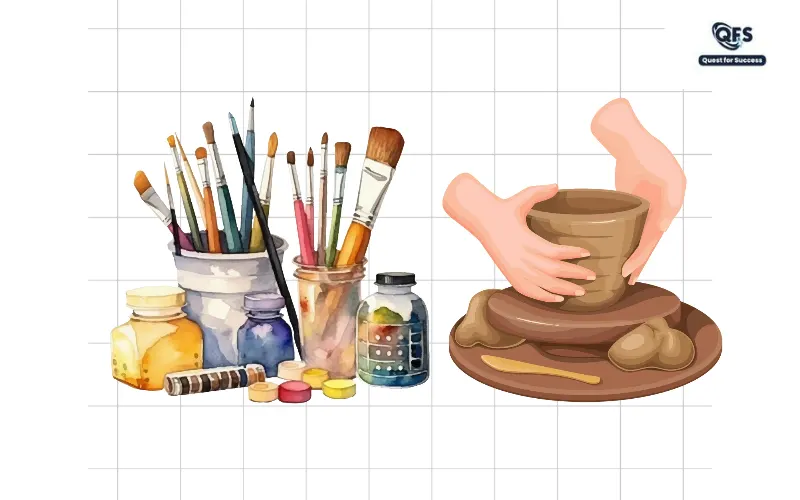
Table of Contents
How AP Art and Design Courses Work
Before comparing the individual courses, it helps to understand what all three AP arts courses share, since the structure is identical across AP 2-D Art and Design, AP 3-D Art and Design, and AP Drawing, only the medium changes. Each course is equivalent to a one-semester, introductory college course in its respective discipline, and none of them end in a traditional written exam. Instead, students submit a digital portfolio through the AP Digital Portfolio made up of two sections: Sustained Investigation, worth 60% of the portfolio score, which documents an extended body of work built around a student’s own inquiry, including both images and written evidence of the process; and Selected Works, worth 40%, which showcases a smaller set of a student’s strongest finished pieces. Each component is scored on a 5-point scale, and the sections combine into one overall portfolio score. Notably, the College Board prohibits the use of generative AI tools at any stage of the creative process for these portfolios, reinforcing that the work submitted must reflect the student’s own artistic development.
AP 2-D Art and Design
AP 2-D Art and Design is an introductory college-level course centered on two-dimensional design, where students develop and apply design skills to their own ideas across the full school year. The course doesn’t prescribe a single medium, instead, it supports work across graphic design, sequential art, photography, collage, printmaking, illustration, industrial design, animation, game design, painting, and fibers, giving students real flexibility in how they demonstrate design thinking. The Selected Works section requires five digital images of finished pieces, while the Sustained Investigation section requires fifteen images documenting an extended, inquiry-driven body of work, alongside written evidence explaining the student’s process of practice, experimentation, and revision. There are no required prerequisites, though prior experience with two-dimensional media, in or out of a formal classroom, makes the course’s pace considerably more manageable.
AP 3-D Art and Design
AP 3-D Art and Design follows the same portfolio structure as its 2-D counterpart but shifts entirely into three-dimensional work, covering disciplines such as sculpture, architecture, jewelry, fashion and apparel design, bookmaking, game design, interior design, and fibers. As with AP 2-D Art and Design, students build an inquiry that guides their artmaking throughout the year, demonstrating skills through practice, experimentation, and revision of materials, processes, and ideas. The key structural difference between the two sits in the Selected Works section: AP 3-D Art and Design requires ten digital images of finished work, double the five required for AP 2-D Art and Design, reflecting the fact that three-dimensional pieces often need multiple angles to be properly represented. The Sustained Investigation section still requires fifteen images plus written evidence, matching the 2-D course. Like AP 2-D Art and Design, there are no formal prerequisites, though hands-on experience creating three-dimensional work is genuinely helpful going in.
AP Drawing: The Third Course in the Family
Rounding out the full set of AP arts courses is AP Drawing, which focuses specifically on drawing-based skills, mark-making, line, surface, space, light and shade, and composition, rather than the broader design focus of the 2-D and 3-D courses. Students can submit work in analog or digital drawing, painting, printmaking, or mixed media, as long as the underlying emphasis stays on drawing skill rather than design or three-dimensional construction. The portfolio structure mirrors AP 2-D Art and Design exactly: five Selected Works images and fifteen Sustained Investigation images plus written evidence. Students interested in more than one discipline can submit more than one AP Art and Design portfolio in the same year, but each must represent a genuinely distinct body of work, submitting the same pieces across two portfolio types isn’t permitted.
Choosing Between the Three AP Art and Design Courses
With all three AP arts courses sharing a similar structure, the real decision comes down to medium, creative interest, and the kind of work a student is already producing.
- Strong interest in graphic, illustrative, or photographic work: AP 2-D Art and Design fits naturally, since it supports a wide range of flat-format media without narrowing students into a single discipline.
- Drawn to sculpture, architecture, fashion, or spatial design: AP 3-D Art and Design is the better fit, giving students room to work in physical, three-dimensional materials and submit multi-angle documentation of finished pieces.
- Focused specifically on drawing and mark-making as a craft, rather than broader design thinking: AP Drawing offers the most concentrated path, emphasizing traditional and digital drawing skills over design application.
- Genuinely multidisciplinary students can consider submitting more than one portfolio, though this means building two entirely separate bodies of work, so it’s worth discussing the realistic workload with a teacher before committing to two portfolios in the same year.
Common Mistakes in AP Art and Design Portfolios
- Treating Selected Works and Sustained Investigation as separate projects. Strong portfolios often let the inquiry developed in Sustained Investigation inform or connect to the pieces chosen for Selected Works, rather than submitting two unrelated sets of work.
- Underestimating the written evidence component. Since Sustained Investigation is partly assessed through written explanation of process, practice, experimentation, and revision, treating this as an afterthought to the images themselves tends to weaken an otherwise strong visual portfolio.
- Missing internal deadlines. Teachers and AP coordinators typically set submission deadlines well ahead of the College Board’s own cutoff specifically to allow time for review and plagiarism checks, so working toward the official deadline alone risks missing the real one.
- Using generative AI tools during the creative process. The College Board prohibits this at any stage of AP Art and Design portfolio creation, and work found to involve it risks disqualification, regardless of how much other work in the portfolio is entirely original.
- Choosing a course based on perceived ease rather than genuine medium fit. Since all three AP Art and Design courses share essentially the same assessment structure and difficulty level, picking based on comfort with a specific medium produces far stronger, more cohesive portfolios than picking based on an assumption that one course is easier than another.
How Quest for Success Can Help
Building a strong AP Art and Design portfolio, whether in 2-D, 3-D, or Drawing, takes sustained planning across the full school year, not a last-minute sprint before the submission deadline. At Quest for Success, we help students choose the AP arts course that genuinely matches their creative strengths, structure a Sustained Investigation that ties together coherently across the year, and prepare Selected Works and written evidence that meet the College Board’s expectations well ahead of internal and official deadlines.
Summary
The AP Art and Design program covers three distinct AP arts courses, AP 2-D Art and Design, AP 3-D Art and Design, and AP Drawing, each assessed entirely through a portfolio rather than a traditional written exam, and each built from the same two sections: a 60%-weighted Sustained Investigation and a 40%-weighted Selected Works. AP 2-D Art and Design spans flat-format media like graphic design and photography, AP 3-D Art and Design spans spatial disciplines like sculpture and fashion design, and AP Drawing concentrates specifically on drawing-based craft. Choosing between them comes down to medium and creative direction rather than difficulty, and success in any of the three depends on sustained, well-documented work across the year rather than a handful of strong finished pieces submitted at the last minute.
FAQs
The medium and the Selected Works requirement. AP 2-D Art and Design covers flat-format work like graphic design, photography, and illustration with five Selected Works images, while AP 3-D Art and Design covers spatial disciplines like sculpture and fashion design with ten Selected Works images, reflecting the need for multiple angles on three-dimensional pieces.
No. All three AP arts courses, 2-D, 3-D, and Drawing, are assessed entirely through a digital portfolio submitted through the AP Digital Portfolio, with no separate multiple-choice or essay exam component.
Yes, but each portfolio must represent a genuinely separate body of work with its own inquiry statement, and your AP coordinator needs to order a separate exam for each portfolio type you submit.
No formal prerequisite is required for either course, though prior experience working in two-dimensional or three-dimensional media, whether in a classroom or independently, makes the course’s pace and expectations considerably more manageable.
No. The College Board prohibits the use of generative AI tools at any stage of the creative process for AP Art and Design portfolios, and this policy applies equally across AP 2-D Art and Design, AP 3-D Art and Design, and AP Drawing.
Deciding between the AP Art and Design courses, or need help structuring your Sustained Investigation before the deadline? Reach out to Quest for Success; we’re here to help you build a portfolio that genuinely reflects your creative strengths.
While You're Here

How to Write a College Application Essay That Works
How to Write a College Application Essay 29th October, 2026...

Ivy League Admissions: A Guide for International Students
Ivy League Admissions for Indian and International Students 29th October,...
WhatsApp us