
IB Chemistry: Complete Subject Guide and Tips to Score a 7
Science drives the world forward. IB Chemistry gives students a deep understanding of matter, reactions, and the physical world. At Quest For Success, we have helped hundreds of students master this subject and achieve top grades.
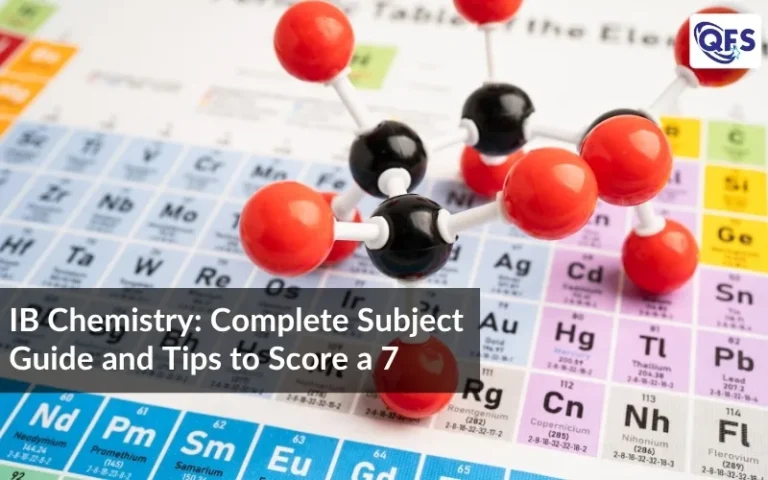
It is one of the most respected IB science subjects globally. Universities in medicine, engineering, and research actively look for it. Whether you are a confident scientist or just starting out, this guide covers everything you need to succeed in IB Chemistry.
What Does IB Chemistry Cover?
The IB Chemistry is offered at both Standard Level (SL) and Higher Level (HL). The syllabus is structured around physical, inorganic, and organic chemistry.
SL students cover core topics across roughly 150 teaching hours. HL students go deeper into additional material over around 240 hours.
Both levels include a practical investigation component. The course develops analytical thinking, data interpretation, and scientific communication. Students learn to connect chemical theory with real-world applications throughout the programme.
Key Topics in the Syllabus
Here are the major areas which IB students must master:
- Stoichiometry and the Mole Concept: Quantitative chemistry forms the foundation of the entire course.
- Atomic Structure and Periodicity: Understanding electron configuration and periodic trends is essential.
- Chemical Bonding: Ionic, covalent, and metallic bonding are tested in depth across both levels.
- Energetics and Thermochemistry: Enthalpy, entropy, and Gibbs free energy are key HL areas.
- Kinetics and Equilibrium: Rate of reaction and Le Chatelier’s principle appear frequently in exams.
- Organic Chemistry: Functional groups, reaction mechanisms, and nomenclature are heavily tested at HL.
- The Internal Assessment (IA): Students complete a 10-hour individual investigation worth 20% of their grade.SL students cover core topics across roughly 150 teaching hours. HL students go deeper into additional material over around 240 hours.
Exam Structure Explained
International Baccalaureate Chemistry is assessed through three external papers and one internal assessment. SL students sit Paper 1 (multiple choice) and Paper 2 (structured questions).
HL students additionally sit Paper 3, which covers options and data analysis. Paper 1 tests recall and understanding. Paper 2 and Paper 3 require extended written responses and calculations. The IA accounts for 20% of the final grade. Time management across all three papers is critical for scoring well.
Why Students Struggle With IB Chemistry
Many students underestimate the depth required at HL. Organic chemistry mechanisms are a common weak area. Students often lose marks by not showing full working in calculations.
Data-based questions in Paper 3 can be tricky without regular practice. The IA is frequently left too late, reducing its quality. Thermodynamics and equilibrium confuse students who rush the foundational topics. Without a structured revision plan, even capable students fall short of a 7.
Tips to Score a 7
Scoring top marks is absolutely achievable with the right approach. Here are proven strategies:
- Master stoichiometry early. It underpins calculations across every topic in the course.
- Use the data booklet actively. Practise navigating it under timed conditions before every exam.
- Show all working in calculations. Partial marks are available even when the final answer is wrong.
- Start your IA early. A well-planned investigation can score full marks and boost your overall grade significantly.
- Use the official IB resource. Explore the IB Chemistry subject page on the IBO website to access the syllabus and specimen papers directly.
- Supplement with university resources. MIT OpenCourseWare’s Chemistry courses offer free lectures that strengthen understanding of difficult HL concepts.
Who Should Take IB Chemistry?
IB Chemistry HL is ideal for students targeting medicine, pharmacy, chemical engineering, or biochemistry. SL suits students who need a science credit but are not pursuing science-heavy university courses. Both levels are valued by universities worldwide.
Students who enjoy logical problem-solving and hands-on experiments tend to do well. You do not need to be a natural scientist — consistent effort and structured practice matter far more than raw ability.
Career Scope After Chemistry
International Baccalaureate Chemistry opens pathways into some of the most competitive fields. Medicine, dentistry, and pharmacy almost universally require a strong chemistry background. Chemical and biomedical engineering also draw heavily from this subject.
Beyond the sciences, fields like environmental consulting, food technology, and materials science value chemistry graduates. Students who achieve a 6 or 7 in IB Chemistry HL are well positioned for selective university programmes globally.
Get into top universities: expert advice on your application
Conclusion
IB Chemistry is challenging, but it is one of the most rewarding subjects in the diploma programme. The skills it builds — analytical thinking, precision, and scientific reasoning — are valuable in every field.
Quest For Success offers expert, personalised tutoring for IB Chemistry at both SL and HL. Our tutors help students build strong foundations, tackle difficult topics with confidence, and prepare thoroughly for every paper. Reach out to QFS today and take the first step towards scoring a 7.
WhatsApp us