

When to Start Preparing for University Applications Register With Quest...
AP Calculus BC: The Ultimate Course Overview & Study Guide
20 July, 2026 | Abhishek Malani | 21 Min Read
Introduction
If you’re staring down a syllabus for AP Calculus BC and doing the math on just how much content you’re about to cram into one school year (spoiler: it’s roughly two full semesters of college calculus, which is a lot of math to fit into a schedule that also includes lunch), congratulations, you’ve officially signed up for one of the most fast-paced, high-reward courses in the entire AP catalog. AP BC Calc, as it’s affectionately shortened by students who have accepted their fate, takes everything from AP Calculus AB and adds parametric equations, polar coordinates, vectors, and an entire unit on infinite series that has made more than a few confident students suddenly question whether numbers can really go on forever (they can, and yes, you need to know exactly how).
At Quest for Success, we’ve built this guide to be the one resource you keep open in a tab all year, from the first week of the course through exam day in May. We’ll walk through exactly what advanced placement calculus BC covers, how the exam is structured and scored, which units carry the most weight, how to build a study plan around that weighting, and how the course fits into your bigger college and career picture. No fluff, no filler, and no pretending that Taylor series are simple just because your teacher explains them cheerfully.
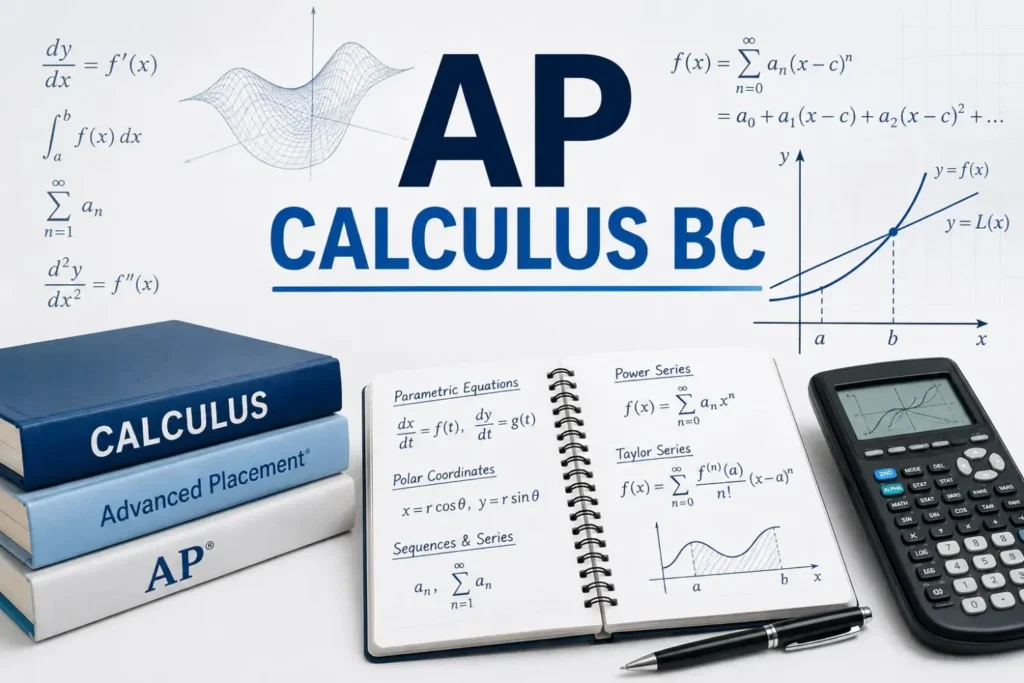
Table of Contents
What Is AP Calculus BC?
AP Calculus BC, officially Advanced Placement Calculus BC, commonly shortened to AP Calc BC or just calculus BC, is a College Board course designed to be the equivalent of two full semesters of introductory college calculus, essentially Calculus I and Calculus II rolled into a single high school year. It covers every topic in AP Calculus AB, limits, derivatives, integrals, and their applications, and then keeps going, adding parametric and polar functions, vector-valued motion, and the entire world of infinite sequences and series.
Across the year, AP Calculus BC trains you to:
- Determine limits, derivatives, and integrals using appropriate rules, formulas, and techniques
- Analyze functions represented algebraically, graphically, numerically, and verbally, and connect those representations
- Model real-world situations involving motion, rates of change, and accumulation
- Justify conclusions using precise mathematical language, not just correct final answers
Unlike a course where you can coast on a right numerical answer, this exam consistently rewards showing why your answer is correct, in complete, mathematically justified sentences. “Because I said so” has never once earned a justification point, no matter how confidently it’s written. The course is organized around 3 Big Ideas and 10 instructional units, which we break down in detail below.
Who Should Take AP Calculus BC?
AP Calculus BC has no official College Board prerequisite, but in practice, it demands a genuinely strong precalculus foundation; comfort with functions, trigonometry, and algebraic manipulation is essential before taking this course, which moves quickly and doesn’t wait for anyone to catch up. Most students take it in their junior or senior year, and, importantly, you cannot take both AP Calculus AB and AP Calculus BC in the same school year; the College Board treats them as overlapping courses rather than a matched set.
You’ll get the most value out of advanced placement calculus BC if you:
- Have a strong precalculus background and enjoy the logic and structure of mathematical proof
- Plan to pursue math, engineering, physics, computer science, or another STEM field in college
- Want a single AP course that can potentially place you out of an entire year of college calculus
- Are comfortable with a fast pace and don’t mind revisiting a topic like series convergence tests roughly four or five times before it finally clicks
Because BC students automatically receive an AB subscore alongside their BC composite score, some students who aren’t fully sure they’re ready for the full BC pace still choose it anyway, reasoning that even a so-so BC performance can translate into solid AB credit. It’s a nice safety net, though it’s not a substitute for actually knowing your convergence tests.
AP Calculus BC Exam Date 2027
The 2027 AP Calculus BC Exam has not been announced yet. For reference, the 2026 exam was administered on Monday, May 11, 2026, as part of the College Board’s annual May testing window (early morning, presumably so your brain has the best possible shot at recalling every derivative rule you’ve ever learned).
Course Structure: The 3 Big Ideas
Everything in AP Calculus BC connects back to three overarching themes the College Board calls Big Ideas. Rather than treating each unit as its own disconnected topic, the course wants you to see how these three ideas resurface constantly, whether you’re differentiating a polar curve or testing a series for convergence:
| Big Idea | Core Theme |
|---|---|
|
Change (CHA)
|
Calculus generalizes the idea of change, from average rates of change to instantaneous rates, and lets you model how quantities evolve over time or space.
|
|
Limits (LIM)
|
Limits underpin nearly every major concept in calculus: continuity, derivatives, and integrals, and mastering them early makes everything that follows more intuitive.
|
|
Analysis of Functions (FUN)
|
Calculus gives you tools to understand a function’s full behavior, its shape, its extrema, and its long-term trends, using calculus-based evidence rather than just a graph’s appearance.
|
Every unit, every skill, and every exam question ties back to one or more of these Big Ideas, which is exactly why calculus BC rewards understanding how these three threads connect a derivative problem to an integral problem to a series problem, rather than treating each unit as its own sealed-off chapter you forget the moment the unit test ends.
AP Calculus BC Units & Exam Weighting
The College Board publishes an official percentage breakdown of how much each unit covers on the exam. This is the single most useful table for planning your study time; units with a wider or higher range deserve more of your hours, and in this course, two units in particular deserve a lot of hours.
| Units | Topic | Exam Weighting | Key Focus/Description |
|---|---|---|---|
|
Unit 1
|
Limits and Continuity
|
4–7% |
The formal definitions of a limit and continuity, and the foundational vocabulary the rest of the course builds on.
|
|
Unit 2
|
Differentiation: Definition and Fundamental Properties
|
4–7% |
The definition of the derivative and basic differentiation rules.
|
|
Unit 3
|
Differentiation: Composite, Implicit, and Inverse Functions
|
4–7% |
The chain rule, implicit differentiation, and derivatives of inverse and inverse trigonometric functions.
|
|
Unit 4
|
Contextual Applications of Differentiation
|
6–9%
|
Related rates, straight-line motion, and derivatives applied to real-world scenarios.
|
|
Unit 5 |
Analytical Applications of Differentiation
|
8–11%
|
The Mean Value Theorem, curve sketching, and optimization using derivative-based analysis; one of the two heaviest-weighted units on the exam.
|
|
Unit 6
|
Integration and Accumulation of Change
|
17–20%
|
U-substitution and the Fundamental Theorem of Calculus; the single heaviest-weighted unit on the exam.
|
|
Unit 7
|
Differential Equations
|
6–9%
|
Slope fields and separable differential equations.
|
|
Unit 8 |
Applications of Integration
|
6–9%
|
Area between curves and volumes of solids using the disc and washer methods. |
|
Unit 9 |
Parametric Equations, Polar Coordinates, and Vector-Valued Functions |
11–12% |
Motion along curves, polar area and slope, and vector-valued functions describing planar motion; exclusive to BC. |
|
Unit 10 |
Infinite Sequences and Series |
17–18%
|
Convergence and divergence tests, Taylor and Maclaurin series, and error bounds; exclusive to BC, and consistently the unit students find most abstract. |
Because Units 6, 9, and 10 together make up nearly half the exam, that trio deserves the largest share of your review time. Units 9 and 10 are entirely exclusive to BC, don’t exist on the AB exam at all, and are the main reason a strong BC score can earn you a full year of college calculus credit rather than just one semester’s worth.
The AB Subscore: A Built-In Bonus
One feature that makes AP Calculus BC genuinely unique among AP exams is the AB subscore. Alongside your regular 1-5 BC composite score, the College Board also calculates and reports a separate 1-5 subscore based solely on the portions of the exam aligned to AP Calculus AB content, essentially Units 1 through 8. No other AP subject generates a subscore like this.
In practice, this means that even if your overall BC composite ends up lower than you hoped, a strong AB subscore can still qualify you for AP Calculus AB college credit at institutions that don’t recognize a full BC score. It’s not a reason to slack off on Units 9 and 10, since they’re still worth roughly a third of your composite, but it does mean the exam is quietly a little more forgiving than it first appears.
Skills You'll Be Tested On
Content knowledge alone won’t get you a 5 on this exam. AP Calculus BC assesses four core mathematical practices across both the multiple-choice and free-response sections:
- Implementing Mathematical Processes: Selecting and applying the correct procedures to solve problems accurately
- Connecting Representations: Translating between algebraic, graphical, numerical, and verbal representations of the same mathematical idea
- Justification: Justifying reasoning and conclusions using precise mathematical language, not just correct final answers
- Communication and Notation: Using appropriate notation, language, and mathematical conventions to communicate results clearly
Every question, whether multiple-choice or free-response, is designed to test one or more of these practices. This is why “I got the right number” tends to underperform on the free-response section: the exam consistently rewards a clearly justified process, “because f'(x) > 0 on this interval, f is increasing,” over a bare final answer with no explanation, even when that final answer happens to be correct.
Exam Format: How AP Calculus BC Is Scored
The AP Calculus BC exam lasts 3 hours and 15 minutes and is a hybrid digital exam: multiple-choice questions are completed digitally through the College Board’s Bluebook app, while free-response answers are handwritten in a paper response booklet. A graphing calculator is required for designated portions of the exam. While the Bluebook includes some built-in tools, most students still bring their own College Board-approved graphing calculator, such as a TI-84 Plus CE or TI-Nspire, for the calculator-active sections.
| Section | Format | Number of Questions | Exam Weight | Time |
|---|---|---|---|---|
|
Section I
|
Multiple-choice (digital, via Bluebook)
|
45 questions
|
50%
|
1 hour 45 minutes
|
|
Section II
|
Free-response (handwritten booklet)
|
6 questions
|
50%
|
1 hour 30 minutes
|
Section I breakdown:
Part A has 30 questions in 60 minutes with no calculator allowed; Part B has 15 questions in 45 minutes with a graphing calculator required. There’s no penalty for incorrect answers, so you should answer every question, even the ones where you’re working from a partial derivation rather than a fully completed one.
Section II breakdown:
Part A has 2 questions in 30 minutes with a calculator required; Part B has 4 questions in 60 minutes with no calculator allowed. Each free-response question is scored out of 9 points on an analytic rubric, for a total of 54 raw points, and no formula sheet is provided; every derivative rule and integral technique needs to live in your memory, not on a reference page.
Scoring:
The multiple-choice and free-response sections are weighted equally to form a composite score, which is then converted to the familiar 1–5 AP scale. Most colleges award credit for a score of 3 or higher, though many selective schools require a 4 or 5. BC, in particular, often earns a full year of college calculus credit for a score of 4 or 5; always check individual college credit policies, since they vary widely.
How Hard Is AP Calculus BC?
Short answer: yes, it’s genuinely rigorous content, moving at genuinely rapid speed, but the results consistently show that the students who choose to take it tend to be strongly self-selected and well-prepared.
By the numbers:
- In 2025, roughly 78.6% of test-takers earned a score of 3 or higher, a slight dip from 2024’s 80.9% pass rate, but still one of the highest passing rates of any AP exam.
- The mean score has hovered in the high 3s in recent years, 3.92 in 2024, 3.75 in 2023, and 3.68 in 2022, notably higher than most other AP exams, including AP Calculus AB.
- Close to half of all test-takers earn the top score of 5 in a typical year, which says less about the exam being “easy” and more about the fact that the students sitting for it have usually already survived a demanding precalculus gauntlet before they ever see the BC syllabus.
Why students find it demanding:
- The sheer pace: Fitting two semesters of college calculus into one high school year means there’s genuinely no “slow week” once the course gets going.
- Unit 10’s abstraction:Infinite series, and specifically knowing which of the roughly half-dozen convergence tests to apply and when, is consistently cited as the single hardest topic in the entire course.
- Justification-heavy scoring:Free-response points depend on precise written explanations, not just correct numbers, and skipping the sentence that says why is one of the most common, avoidable ways to lose points.
The upside: because the skills this course builds, rigorous logical justification, comfort moving between multiple representations of a function, and modeling real change, transfer directly into nearly every STEM field, and because a strong score can genuinely replace an entire year of college math requirements, students consistently rate AP Calculus BC as one of the most practically valuable AP courses they take, even while venting about series convergence at 11 p.m. the night before a unit test.
How to Build a Study Plan Around Unit Weighting
The smartest way to study for AP Calculus BC isn’t to treat all 10 units as equally urgent; it’s to move briskly through the AB-style foundational units, so you have real time left for the three heavyweight units that make up nearly half the exam.
A sample 10-week study framework:
| Timeframe | Units to Study |
|---|---|
|
Weeks 1–2
|
Unit 1 (Limits and Continuity) and Unit 2 (Differentiation: Definition and Fundamental Properties).
|
|
Week 3
|
Unit 3 (Differentiation: Composite, Implicit, and Inverse Functions).
|
|
Week 4
|
Unit 4 (Contextual Applications of Differentiation).
|
|
Weeks 5-6
|
Unit 5 (Analytical Applications of Differentiation) and Unit 6 (Integration and Accumulation of Change), the two heaviest-weighted units; give them real, dedicated time. |
|
Week 7
|
Unit 7 (Differential Equations) and Unit 8 (Applications of Integration).
|
|
Week 8
|
Full-length practice exams, targeted review of your weakest units, and timed multiple-choice and free-response drilling.
|
|
Week 9 |
Unit 10 (Infinite Sequences and Series), the most abstract unit on the exam; don’t rush this one.
|
|
Week 10 |
Full-length practice exams, targeted review of your weakest units, and timed multiple-choice and free-response drilling. |
A few study principles that consistently pay off:
- Take a full diagnostic test early to identify which units need the most attention; don’t guess.
- Prioritize official College Board materials. Past free-response questions, scoring guidelines, and sample responses are publicly released and are the gold standard for practice; always check your work against them rather than unofficial sources.
- Memorize your derivative and integral rules cold. Since no formula sheet is provided, hesitation on basic rules costs you time you can’t get back on Units 6 and 10 especially.
- Practice writing full justification sentences, not just final answers, for every free-response practice problem you do; this habit is what actually earns points on exam day.
- Don’t neglect Units 1 through 5 just because they’re lower-weighted individually. They’re the foundation on which everything else in the course depends, and shaky basics tend to surface as costly mistakes in the heavier units.
At Quest for Success, our AP Calculus BC preparation programs are built around exactly this kind of weighted, data-informed study plan; we help students move efficiently through foundational units and dedicate real time to Units 6, 9, and 10, building a personalized roadmap toward their target score rather than a generic one-size-fits-all review schedule.
The Free-Response Component: Six Questions, Two Modes
Just as a lab component anchors a science AP course, sustained free-response practice anchors AP Calculus BC, and this is where half of your exam score is actually earned. Over the course of the year, students typically work through dozens of timed and untimed free-response problems across both calculator-active and calculator-free conditions.
- Calculator-active questions build your ability to use a graphing calculator efficiently for tasks like evaluating definite integrals, finding zeros, and analyzing graphs, without losing time fumbling through calculator menus under pressure.
- Calculator-free questions sharpen your ability to work through derivatives and integrals by hand, precisely and without shortcuts.
- Consistent, timed practice across both modes builds the pacing instinct needed to move through six substantial questions in 90 minutes without running out of time on the last one.
A response that states “the particle is speeding up” earns little credit on its own; a response that says “the particle is speeding up because velocity and acceleration have the same sign at t = 2” demonstrates exactly the kind of justified reasoning the rubric rewards. Keeping an organized set of practice free-response questions throughout the year, and reviewing which rubric points you consistently earn or miss, is genuinely useful exam prep, not just a homework requirement.
What to Bring on Exam Day
Because AP Calculus BC is a hybrid digital exam, your exam-day checklist blends both the digital and paper-testing eras:
- A fully charged device with the Bluebook app pre-installed (confirm with your AP coordinator whether your school provides a device or requires you to bring your own)
- A power cord or portable charger
- An approved graphing calculator (check the College Board’s approved list; models like the TI-84 Plus CE and TI-Nspire are common choices)
- Pens with blue or black ink for the free-response booklet
- Pencils for scratch work and annotations
- A valid photo ID (required if testing outside your own school)
Do not bring: notes, textbooks, study materials, a formula sheet of your own making, or your own scratch paper (scratch paper is provided). Cell phones and smartwatches must be turned off and stored away for the duration of the exam. And no, your calculator’s built-in games will not help you here; the proctors have, unfortunately, seen it all and still said no.
Top Majors AP Calculus AB Supports
A strong AP Calculus BC score signals rigorous quantitative reasoning and problem-solving skills, both of which carry serious weight in college admissions and can translate into real college credit, often a full year’s worth, depending on each institution’s policy.
Majors and fields AP Calculus AB provides a strong foundation for:
| Majors/Fields | Why it provides a strong foundation |
|---|---|
|
Mathematics |
The most direct extension of the course’s content and analytical rigor. |
|
Engineering (all disciplines)
|
Nearly every engineering major builds directly on the differentiation and integration skills this course develops.
|
|
Physics
|
Motion, rates of change, and modeling concepts map closely onto introductory physics coursework. |
|
Computer Science
|
Algorithmic thinking and mathematical modeling skills transfer well into computer science theory and applications.
|
|
Economics and Finance
|
Rates of change and optimization concepts underpin introductory economic and financial modeling.
|
|
Data Science and Statistics
|
A foundation in calculus supports later coursework in probability and statistical methods.
|
|
Chemistry
|
Rate of reaction and modeling concepts connect directly to physical chemistry coursework.
|
|
Pre-Med and Biological Sciences
|
Many pre-med tracks and biology programs require a semester of calculus, and a strong AB score can fulfill that requirement outright.
|
Colleges generally award credit or placement for scores of 3 or higher, though many selective universities set the bar at 4 or 5 specifically for this exam, and a strong BC score frequently earns a full year of college calculus credit rather than just one semester. Because policies vary significantly by institution, it’s worth checking each target college’s official AP credit policy before assuming credit will transfer.
How Quest for Success Can Help
AP Calculus BC rewards students who study strategically, not just hard. At Quest for Success, our mission is to be your trusted companion through the entire AP BC Calc journey, breaking the syllabus down unit by unit, helping you prioritize based on real exam weighting, and building the justification and problem-solving skills the exam actually tests.
Whether you’re just starting the course or in the final stretch before the May exam, our AP Calculus BC preparation programs are designed to meet you where you are, with structured review, guided feedback on real free-response responses, and a study plan built around your personal strengths and gaps, not a generic checklist.
Summary
AP Calculus BC is the College Board’s fast-paced equivalent of two full semesters of college calculus, covering everything in AP Calculus AB plus BC-exclusive topics like parametric and polar functions, vector-valued motion, and infinite sequences and series. The course is organized around 3 Big Ideas, Change, Limits, and Analysis of Functions, and 10 units, with Unit 6 (Integration and Accumulation of Change, 17–20%), Unit 9 (Parametric Equations, Polar Coordinates, and Vector-Valued Functions, 11–12%), and Unit 10 (Infinite Sequences and Series, 17–18%) together making up nearly half the exam. Every question tests one of four mathematical practices: Implementing Mathematical Processes, Connecting Representations, Justification, and Communication and Notation, with justification-heavy scoring among the exam’s most distinctive features. A unique feature of this exam is the AB subscore, a separate 1–5 score based only on AB-aligned content that can earn AP Calculus AB credit even if a student’s full BC composite is lower.
The hybrid digital exam runs 3 hours 15 minutes: 45 multiple-choice questions split between a no-calculator Part A and calculator-required Part B (1 hour 45 minutes, 50%, completed in Bluebook), and 6 free-response questions split between a calculator-required Part A and no-calculator Part B (1 hour 30 minutes, 50%, handwritten in a paper booklet), with no formula sheet provided. Students who choose BC cannot also take AB in the same year. Recent data show a mean score around 3.92 and a pass rate near 78.6%, among the highest of any AP exam, largely because students who take it tend to arrive with strong precalculus foundations. The strongest study plans move briskly through the foundational units, dedicate serious, focused time to Units 6, 9, and 10, memorize all derivative and integral rules since none are provided on exam day, and practice writing complete, justified explanations rather than bare final answers.
FAQs
No. The College Board explicitly prohibits taking both AP Calculus AB and AP Calculus BC exams within the same year, since BC’s content fully encompasses AB’s. Most students choose one or the other based on their precalculus readiness and math trajectory.
45 multiple-choice questions split into a no-calculator Part A (30 questions, 60 minutes) and a calculator-required Part B (15 questions, 45 minutes), totaling 50% of your score, plus 6 free-response questions split into a calculator-required Part A (2 questions, 30 minutes) and a no-calculator Part B (4 questions, 60 minutes), the other 50% of your score.
Most colleges award credit for a score of 3 or higher, though many selective schools require a 4 or 5. A strong BC score often earns a full year of calculus credit rather than just one semester. Always verify with each individual college’s AP credit policy.
Alongside your BC composite score, you automatically receive a separate 1–5 AB subscore based only on the AB-aligned portions of the exam. This can qualify you for AP Calculus AB credit at schools that don’t recognize a full BC score, even if your overall BC composite ends up lower than you hoped.
Yes. AP exams are offered every year, and there’s no limit on how many times you can retake the exam. You also control which scores are sent to colleges, so a lower score doesn’t have to affect your application.
Have questions about building your AP Calculus BC study plan or want personalized guidance? Reach out to Quest for Success; we’re here to help you make the most of your year in the course, from your first limit problem to your last volume-of-revolution problem and exam day in May.
While You're Here

University: A Guide to Higher Education Success
Planning Your University List for Better Admission Results Register With...
AP Test Centres 2026: What You Need to Know
AP Test Venue Guide: What You Need to Know Register...
Get in touch with us
Book a Free Consultation, Diagnostic Test, or Demo Class for Test Prep, Tutoring & UG College Counseling.
Call / WhatsApp Us
Email Us
info@questforsuccess.in
Location
Bangalore, India
Email Us
Office Location
Bangalore, India
Follow Us
Get Started
WhatsApp us